Identity verification typically sits directly before the most critical moment in a digital transaction — checkout or account creation. When identity verification systems fail, users abandon transactions, and businesses feel the revenue impact immediately.
Consider a hospitality example. A customer is mid-booking on a hotel website. After entering their travel dates and payment information, the final step is to log into their loyalty account to secure a discounted rate and confirm their identity. They go through the friction of submitting all their booking details, only for the verification service to return an error in the last moment.
From the customer’s perspective, the hotel website simply “doesn’t work”. They have way of knowing the failure came from a third-party identity service. The result is the same: they close the portal and book with a competitor. Although the outage originates with an external party, the front-facing hotel brand absorbs the business loss.
Situations like this illustrate why organizations evaluating identity verification platforms must treat resilient architecture as a core requirement. To avoid downtime and lost revenue, businesses need two layers of resilience:
- Infrastructure resilience — ensuring service availability even when the vendor’s cloud service provider has an outage.
- Verification services fallbacks — ensuring verification continues even when individual verification methods and their associated services are down.
Below, we break down both layers.
Infrastructure resilience
Modern applications rely on cloud infrastructure for scalability and convenience. Yet cloud giants like AWS, Microsoft Azure, and Google Cloud are not immune to outages. In high-profile incidents, issues with a single cloud provider have caused disruptions across the Internet. One AWS outage recently “ricocheted across more than 1,000 sites,” freezing transactions and taking services offline.
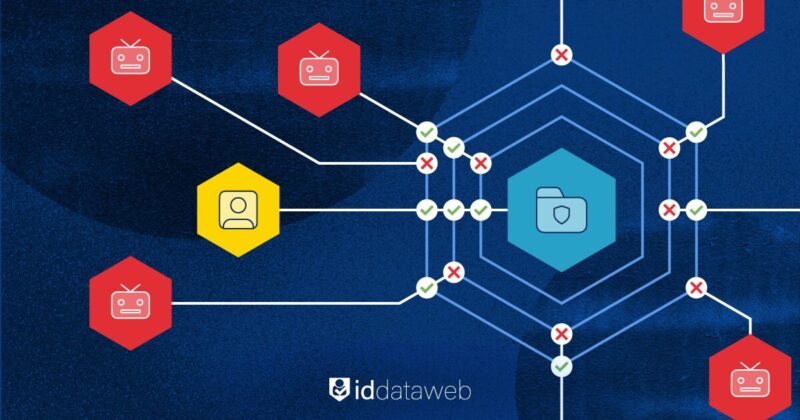
For identity verification, infrastructure resilience means staying operational even when the underlying hosting platform has problems. ID Dataweb is designed so that if its cloud service provider experiences an outage, service continues through redundant systems. If a primary cloud region fails, traffic can be rerouted to a standby region with the same services already running. Meanwhile, data replication ensures the backup environment has current configurations, workflows, and system state, not yesterday’s snapshot. The outcome is minimal customer impact — identity checks proceed smoothly, even when the company’s cloud service provider is having a bad day.
Fallbacks and service-level resilience
Identity verification and threat detection platforms ingest a variety of authoritative identity sources and risk signals that are often delivered through external service providers like government ID databases, credit bureaus, mobile phone carriers, biometric matching services, and more. These third-party providers supply the data and risk signals needed for verification — for example, matching a driver’s license to a government record or delivering an OTP via SMS.
But what happens when one of these providers goes down?
If an identity verification or threat detection platform only ingests a single data source or risk signal for a specific verification step, that step becomes a single point of failure. A provider outage translates directly into failed customer transactions — even if the end user’s own systems are running perfectly.
This is exactly what happened in our hospitality example. To the user, it doesn’t matter where the failure occurred. They simply couldn’t complete their task, so they take their business elsewhere.
A resilient identity verification or threat detection platform leverages multiple service providers for its authoritative data sources or risk signals for each verification step. If Provider A times out or returns an error, the system automatically retries with Provider B — all without the end user noticing. A dynamic orchestration layer monitors failures and reroutes requests in real time.
ID Dataweb is built on this principle. The platform delivers a comprehensive library of authoritative identity sources and risk signals to power a broad range of verification steps that can even be “chained” together. For the vast majority of these verification steps, it provides automated failover. If one document verification source is slow or offline, the platform seamlessly switches to another. Identity verification and threat detection continue uninterrupted, protecting both customer experience and revenue.
Conclusion
The hospitality example could have ended differently with a more resilient identity verification platform in place. The booking would have succeeded, and the hotel would have kept the customer. Multiply that by thousands of transactions, and the revenue impact becomes clear.
An always-on identity security service creates a smoother customer experience and ensures that even during broader Internet incidents — from cloud outages to failures at third-party data providers — enterprise systems stay operational.
Resilience may not be the flashiest topic in the identity verification and threat detection space, but it is unquestionably one of the most critical. Keeping your digital business running despite disruptions in the wider ecosystem is a significant competitive advantage.
For any enterprise implementing identity verification or identity threat detection and risk mitigation solutions, resilience shouldn’t be optional — it should be foundational.