
Fraud schemes are surging in both volume and sophistication, increasing pressure on businesses to protect user accounts. Nearly 80 percent of companies experienced a payment fraud attempt in 2024. New account openings posed the greatest risk, with credit reporting firm TransUnion estimating that 6.5 percent of all global digital account openings were fraudulent. Among the 801 businesses TransUnion surveyed, the estimated combined fraud losses reached $359 billion.
Enterprises have long relied on static, one-size-fits-all authentication methods such as passwords and basic two-factor prompts. Unfortunately, determined attackers have learned how to bypass these defenses. Phishing, social engineering, and SIM-swapping attacks routinely defeat basic login credentials and SMS codes.
Attackers thrive on predictability. When every customer encounters the same authentication flow, a fraudster who defeats it once can repeat the attack at scale. What is needed is an approach that dynamically adjusts defenses based on risk. Rather than increasing friction for all users, enterprises must detect risky sessions and selectively challenge them through step-up authentication. Identity threat detection and risk mitigation solutions make this possible.
How step-up authentication works
Step-up authentication is an adaptive response that applies stronger identity checks only when context indicates elevated risk. For normal, low-risk interactions, users proceed with minimal friction. When behavior appears unusual, the system increases authentication requirements by adding an additional verification step.
A standard username and password login serves as the first checkpoint. If a user signs in on premises using a trusted company device, access may be granted without further challenge. However, if a login attempt originates from a new device or an unexpected location, authentication steps up and requests additional proof of identity.
Depending on policy configuration, this added verification may involve sending a one-time code to a verified device or requiring the user to submit a photo ID and selfie for liveness detection. This targeted approach strengthens security while minimizing unnecessary disruption for legitimate users.
Why risk assessment is key to effective step-up authentication
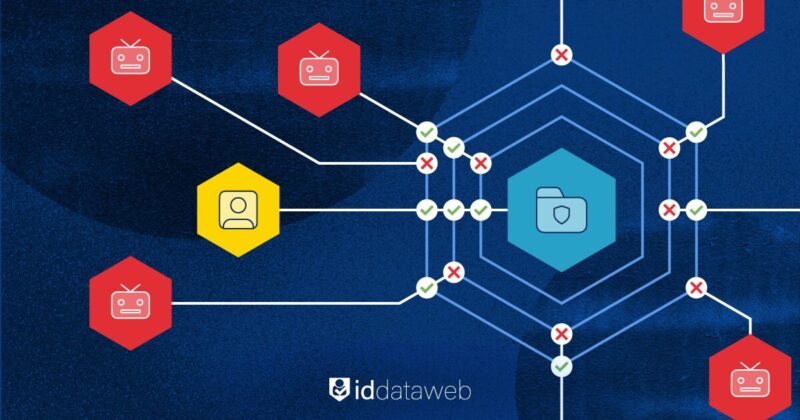
Determining when a step-up challenge is required depends on risk assessment. Identity threat detection systems collect a wide range of risk signals, including device characteristics, network attributes, and behavioral patterns. These risk signals are evaluated together to assess the risk of each interaction.
All risk signals feed into a decision engine. When risk exceeds a defined threshold, the engine routes the user into a step-up authentication flow. Both the threshold and the verification path can be tailored by scenario and aligned with an organization’s risk tolerance. In some cases, high-risk actions such as wire transfers may be blocked outright. More commonly, moderate-risk events such as logins from unfamiliar devices trigger additional verification.
If activity remains below the risk threshold, the user proceeds without interruption. This approach strengthens security while preserving a smooth user experience for the vast majority of interactions.
Identity threat detection systems also offer adaptability. Fraud tactics evolve continuously, requiring security teams to regularly reassess what constitutes risky behavior. Decision engines allow policies to be adjusted quickly as new threats emerge. When analysts identify patterns such as concentrated attacks from specific regions or repeated behavioral signals, they can tighten controls around those indicators.
Early detection is another key advantage. Sophisticated attackers often use a slow, incremental approach during account takeovers, making small changes to avoid triggering alerts. Risk-based monitoring is well-suited to detecting these subtle deviations. Prompting step-up authentication at the first sign of anomalies helps stop account takeovers before significant damage occurs.
Conclusion
From a security perspective, step-up authentication combined with identity threat detection significantly strengthens defenses against account compromise. These layered controls introduce challenges that are far more difficult for fraudsters to bypass than static authentication alone. Even if an attacker defeats one or two layers, additional checkpoints tied to the legitimate user’s identity remain.
Modern identity fraud prevention requires dynamic defense strategies that combine rich risk intelligence with intelligent verification. Step-up authentication and identity threat detection enable enterprises to closely examine high-risk sessions and effectively prevent account takeover and payment fraud.